The project's first scientific paper introduces a foresight-driven AI framework for translating skills intelligence into education, workforce and innovation transformation.
The first scientific paper emerging from the Erasmus+ SKILLBRIDGE project has been accepted for presentation at ITU Kaleidoscope 2026, the flagship peer-reviewed academic conference of the International Telecommunication Union (ITU), taking place in Geneva as part of the AI for Good initiative. The acceptance marks an important milestone in the project's scientific contribution and international visibility.
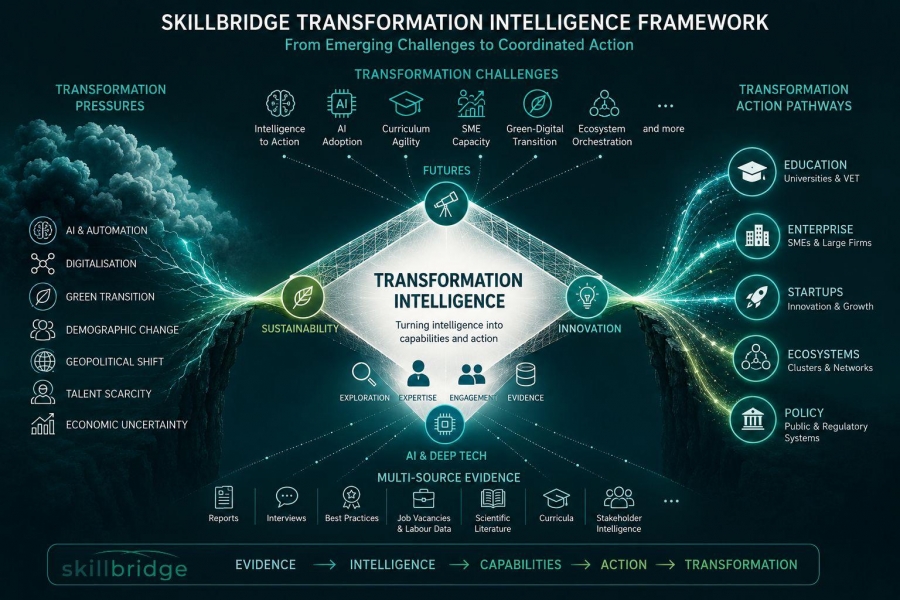
The paper, "From Skills Intelligence to Transformation Intelligence: A Foresight-Driven AI Framework for Curriculum Modernisation, Workforce Development and Innovation Ecosystems," presents the first integrated articulation of the SKILLBRIDGE Skills Observatory, Capability Architecture and Transformation Intelligence Framework.
Drawing on evidence from 120+ stakeholder interviews, 25 best-practice cases, 140+ reports and policy documents, AI-supported labour-market intelligence, scientific literature, and programme-level analyses across five European countries, the paper explores a fundamental question:
What if the future of skills observatories is not simply to identify emerging skills, but to help translate intelligence into capabilities, capabilities into action, and action into transformation?
The paper argues that the next generation of AI-supported skills observatories should evolve beyond skills monitoring towards participatory transformation intelligence systems that connect foresight, capability development and coordinated action across education, enterprises, innovation ecosystems and public policy.
In the authors' words
For Dr Rafael Popper, Scientific Coordinator of SKILLBRIDGE, the milestone is striking precisely because of how early it arrives: "We are only entering the second semester of a project that officially started in November 2025. The fact that we have already been able to articulate this framework reflects the extraordinary commitment of the consortium and the active engagement of educators, learners, enterprises, innovators and policymakers from day one." He frames the paper as more than a research output: "The challenge is no longer simply to anticipate change; it is to build the collective capability to respond to it. That is the journey SKILLBRIDGE has been exploring — moving from skills intelligence to capability intelligence and ultimately to transformation intelligence. This is just the beginning."
For Dr Álvaro Sicilia, the work also became an exploration of how AI can support research itself: "Large language models can take on some of the time-consuming yet important tasks — extracting insights from large volumes of documents, structuring evidence, comparing concepts and spotting overlaps. But the real value lies in well-designed workflows where instructions, models and results are carefully tested, validated and reviewed, ensuring that expert criteria remain central across the entire process."
For Manuel Cerezo, the hardest part was invisible from the outside: "The technical challenge was never simply to extract data; it was creating meaningful connections between very different sources — stakeholder interviews, best-practice cases, labour-market intelligence, scientific literature, policy reports and educational programmes — so that intelligence could be translated into capability priorities and support decision-making across different contexts. It highlights the growing importance of combining data science with systems thinking when addressing complex societal and workforce challenges."
Congratulations to the full author team — Dr Rafael Popper, Dr Álvaro Sicilia, Manuel Cerezo and David Larrosa Camps — and a special thank you to all SKILLBRIDGE partners for helping turn an ambitious idea into a rapidly evolving European capability and transformation ecosystem. With two and a half years still ahead, the best is yet to come.